MDR
Managed Detection and Response
Overview
Overview
What to expect
Features
Bring calm and confidence
to your cyber security
Security needs
Security needs
What best describes your current situation?
Use cases
Overview
Actively looking for a provider
Unhappy with current provider
Want to augment capabilities
Considering outsourcing
Case study
CymruSOC
Protecting vital public services in Wales by detecting and responding to threats, 24/7
Read more
Resources
All resources
Blogs
Case studies
About
About us
Explore our company and values
Company
Company
Partners
News
Careers
Latest insights
Jisc Security Conference 2026: how universities stay ahead of the curve
Read more
Sleepless in security: How stress impacts the wellbeing of cyber security leaders
Read more
Get in touch
Get in touch
Discover all our latest content
All
Blogs
Case studies
Datasheets
eBooks
News & press releases
Reports
Threat alerts
Webinars
Blogs
View all blogs
Blogs
The hidden costs of building a 24/7 internal security team in the UK
Blogs
Jisc Security Conference 2026: how universities stay ahead of the curve
Blogs
Co-managed SOC vs outsourced MDR, comparing cost and capability
Case studies
View all cases
Case study
Historic England
Securing England’s history with 24/7 threat detection and response
Case study
NHS Foundation Trust
Scaling detection and response to safeguard specialist patient care
Case study
interactive investor
Extending the security operations of the UK’s leading subscription-based investment platform
Datasheets
View all datasheets
Datasheet
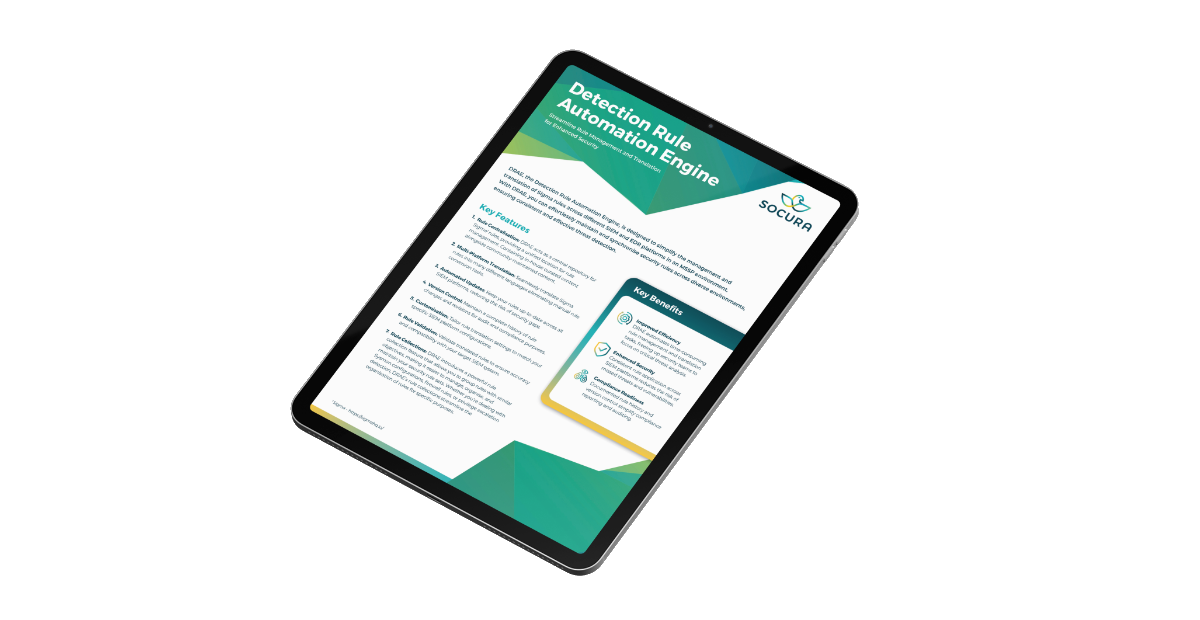
Detection Rule Automation Engine
Learn how DRAE enhances Socura MDR, ensuring fast and effective deployment of threat detection rules.
Datasheet
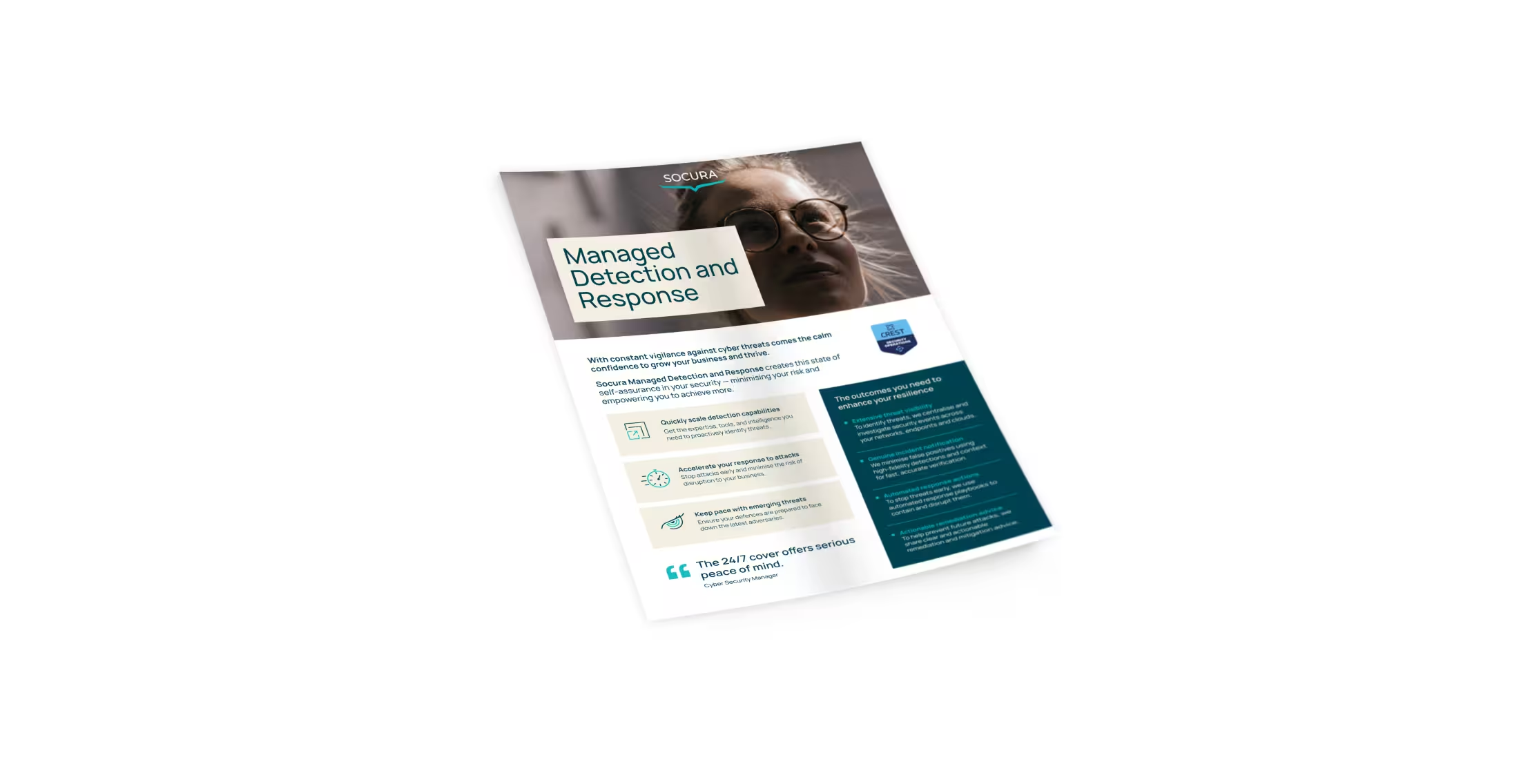
Managed Detection and Response
An overview of our MDR service and the outcomes you can expect.
eBooks
View all ebooks
eBook
24/7 SOC guide
What genuine round-the-clock security really takes, and how to choose the right approach for your organisation.
eBook
Beyond the noise
Is your security provider giving you confidence, or just meeting its SLAs? Spot the 7 signs it’s time for a change.
News & press releases
View all news
News
Andy Kays named ‘One to Watch’ in The LDC Top 50 Most Ambitious Business Leaders for 2025
News
Exclusive webinar - introducing our Exposure Management Service
News
Socura named #3 Fastest-growing and #2 Emerging MSSP globally in 2026
Reports
View all reports
Reports
Sleepless in security
Wellbeing in cyber and the challenges keeping security leaders awake at night.
Reports
A wave in cyber
Analysing the growth, diversity, and regional footprint of the UK cyber security workforce through ONS occupation data.
Reports
FTSE 100 for sale
An analysis of stolen credentials and passwords across the UK’s biggest businesses
Reports
UK employment trends report 2024: Their next job was in cyber
Learn about the latest cybersecurity employment trends in the UK.
Threat alerts
View all alerts
Threat alert
November 19, 2026
NGINX2Root (CVE-2026-123007 & Related Flaws)
NGINX2Root is a collection of five critical memory-corruption vulnerabilities ( tracked as CVE-2026-123007, CVE-2026-123633, CVE-2026-123634, CVE-2026-121810, and CVE-2026-113425 ) affecting NGINX Open Source and NGINX Plus releases from version 1.9.5 onward. Disclosed on November 18, the lead flaw resides in NGINX's HTTP/2 flow-control implementation. Researchers at Xint and Wiz demonstrated pre-authentication remote code execution (RCE) against default HTTP/2 over TLS configurations across AWS, GCP, and Azure, and Xint further chained this worker-level access with an unpatched Linux kernel SCTP vulnerability to achieve full host root; including breaking out of Docker containers.
November 19, 2026
Threat alert
November 18, 2026
Java2Shell (CVE-2026-114938)
Java4Shell (also referred to as Java2Shell) is a critical heap memory-corruption vulnerability tracked as CVE-2026-114938 affecting OpenJDK and derivative Java runtimes from version 17.0.6 onward. Disclosed on November 17, 2026 by Calif alongside coordinated security updates from Oracle and the OpenJDK project, the flaw resides in HotSpot's hardware-accelerated Base64 decoder. Researchers at Calif demonstrated pre-authentication remote code execution (RCE) against default configurations of six major enterprise platforms, though exploitation is strictly constrained to x86-64 hosts with AVX-512 VBMI CPU support where untrusted input reaches "java.util.Base64.Decoder".
November 18, 2026
Threat alert
October 21, 2026
PHP Core Remote Code Execution Vulnerabilities (CVE-2026-109618 & CVE-2026-109619 )
In October 2026, two critical remote code execution vulnerabilities were identified in the core PHP interpreter engine, tracked as CVE-2026-109618 and CVE-2026-109619. Stemming directly from low-level memory management and request-processing routines rather than user-land application logic, these flaws leave standard deployments of widely used web platforms ( such as WordPress, Magento, Drupal, Shopware, WooCommerce, and Laravel) exposed across all major release branches dating back to PHP 5.4.0.
October 21, 2026
Webinars
View all webinars
Webinar
FTSE 100 for sale: The scale of credential theft facing UK companies
How safe are UK companies from credential theft? Join experts from Socura and Flare as we unpack the findings of our joint report.